My Personality
Defender (ISFJ-A)
Defenders are very dedicated and warm protectors, always ready to defend their loved ones. These unassuming types are efficient and responsible, always opting for practicality in life.

MRT Student · Introvert · Assertive
This is my summary of the course, as well as an exploration of my own personality and mindset. Through this experience, I've come to realize that I am an introvert: I don't talk much, I enjoy thinking, I'm somewhat resistant to new technologies, and I prefer a stable and comfortable life. At the same time, I have come to understand that as an MRT, I must embrace the concept of lifelong learning, learn to empathize with patients' emotions, respect their cultural backgrounds, and master effective and efficient communication with them. There is a gap between who I am now and who I aspire to become, but I am constantly improving. I believe that in the future, I will not only possess sufficient knowledge but also be well-prepared in terms of character and communication skills to face whatever lies ahead.
A quick look at my personality profile, including my type, role, strategy, and core traits.
My Personality
Defenders are very dedicated and warm protectors, always ready to defend their loved ones. These unassuming types are efficient and responsible, always opting for practicality in life.
My Role
Sentinels are cooperative and practical, embracing and creating order, security, and stability. They're hard-working, meticulous, and traditional, preferring to stick to their plans.
My Strategy
Those who prefer the Confident Individualism Strategy like doing things alone, choosing to rely on their own skills and instincts instead of seeking contact with other people. They know what they are good at.
These are the values that I cherish the most now. They lead my actions.
The feeling of being protected or safeguarded from danger; a sense of comfort.
The need for solitude or separateness.
A concern for the security and well-being of one's self and/or others.
Richness in terms of assets or money.
Things that engage attention and/or emotion in a lively, stimulating, and compelling way.
These three values are drawn from the five core values above. They are the ones that most clearly shape how I make decisions, define stability, and judge whether a situation feels right to me.
| Selected core value | Why this value matters to me | A moment when I lived this value | How I may react when this value is not honored |
|---|---|---|---|
| Security | I value security because I want a stable, low-risk life. When things feel safe and predictable, I can focus on my plans instead of reacting to uncertainty. | I choose safe places to live and rest, and I pay attention to environments that help me feel protected. | If this value is not respected, I may feel anxious and defensive. I can understand that others see it differently, but I become upset when my sense of safety is disrupted. |
| Wealth | I want enough money to support a normal life without constant financial pressure. To me, wealth means having room to make practical choices instead of feeling restricted. | I avoid spending money randomly so that I can save it for real needs and future responsibilities. | I can understand why some people prefer to enjoy the present, but I may worry that ignoring savings now can lead to difficulties later. |
| Excitement | I believe life needs emotion, movement, and meaningful experiences. Without excitement, life can feel too mechanical and emotionally flat. | Leaving my country to begin a new life abroad was a major moment of living this value. It brought challenge, uncertainty, and real emotional depth. | When this value is missing, I may feel that life becomes too numb or routine. I tend to think people can become stable but emotionally disconnected when excitement is absent. |
These are the I want to express more fully in daily life. The table helps turn those values into practical habits, not just ideas I agree with in theory.
| Value I want to live more fully | What I already do | What I could stop doing | What I could start doing |
|---|---|---|---|
| Reliability | I do not make promises lightly, and once I commit to something, I try hard to follow through. | I should pause before promising help in moments of excitement so I do not agree too quickly and regret it later. | I can bring more consistency to every task so that others see my effort, ability, and trustworthiness more clearly. |
| Creativity | I already explore my own study methods instead of following advice mechanically, and I sometimes make small DIY decorations at home. | I should stop getting too stuck in old ways of thinking or doing things. | I can challenge myself to think more broadly, experiment more often, and step outside familiar patterns. |
| Achievement | I have performed well in school over the years, so I already have a foundation of discipline and effort. | I should stop ignoring things I dislike, such as socializing, when they may actually help me grow and achieve more. | I can explore more options, take more chances, and stay open to opportunities that lead to meaningful achievement. |
In our group, we chose one point under the health topic and finished all the questions. The group collaboration was both successful and efficient. Everyone contributed actively and worked well together.
We call upon those who can effect change within the Canadian health-care system to recognize the value of Aboriginal healing practices and use them in the treatment of Aboriginal patients in collaboration with Aboriginal healers and Elders where requested by Aboriginal patients.
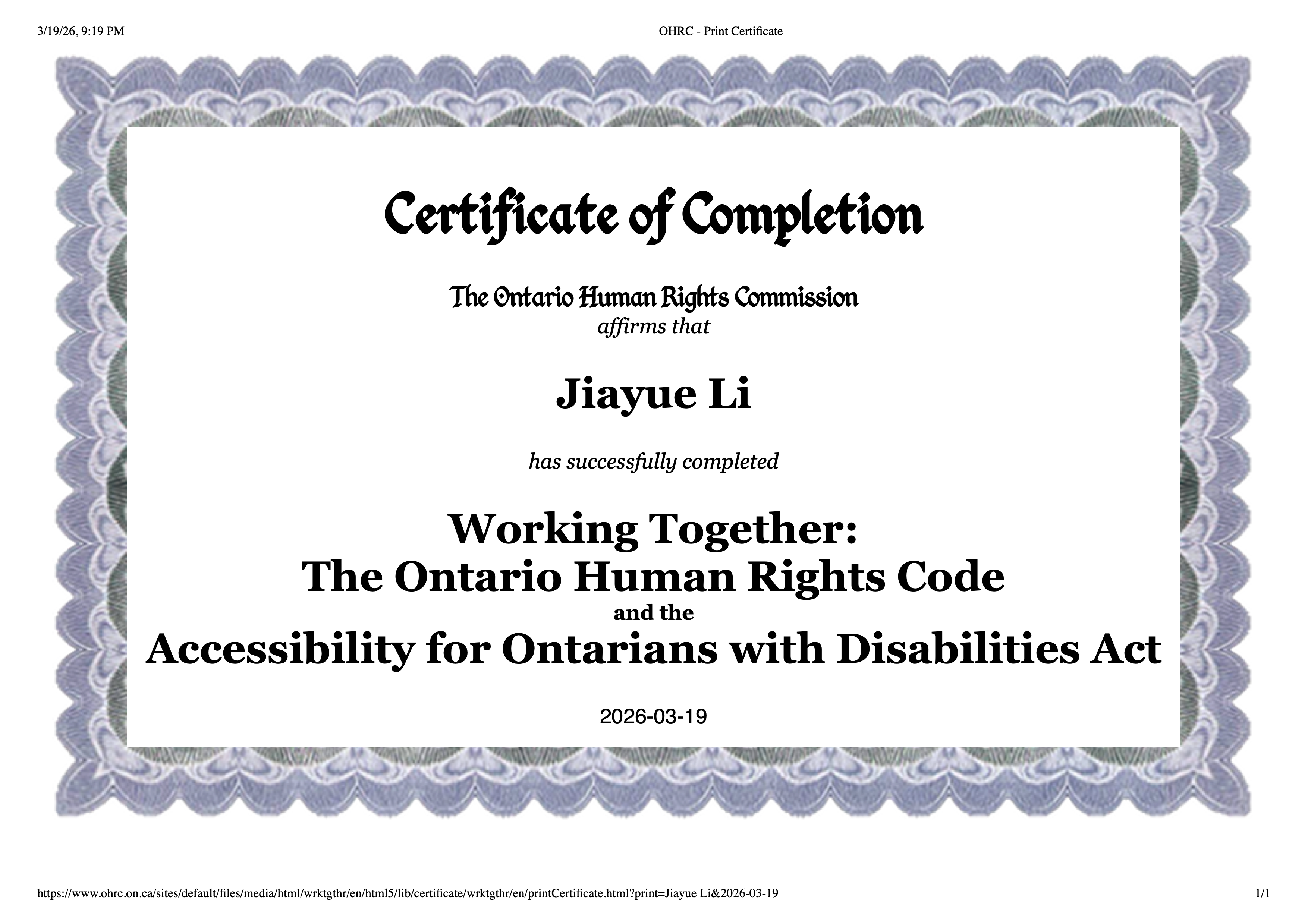
This certificate records my completion of Ontario Human Rights Commission training.